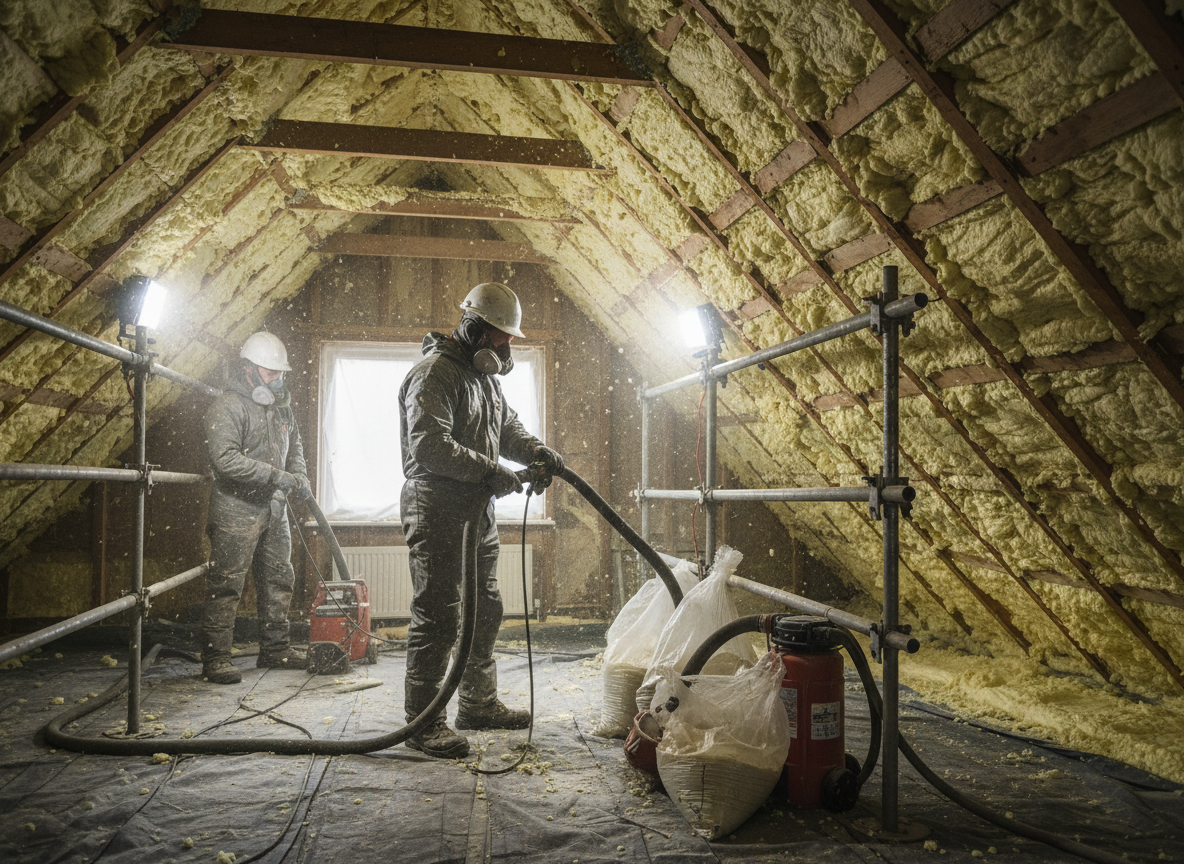
Telford’s post-war housing stock, particularly the 1960s and 1970s estates in Halesfield, Dawley and Sutton Hill, often received closed-cell spray foam in lofts during later retrofit attempts. Over time this traps moisture against rafters, reduces ventilation and can lead to timber decay in the area’s damp Shropshire climate. Removal requires careful separation from original felt and timber without damaging the roof structure that was never designed for modern breathable membranes.
Homeowners in Telford frequently discover the foam has been applied over electrical cables and junction boxes, creating hidden fire and access risks. Extraction must be done in sections using negative-air machines to prevent dust migration into living spaces below, especially in terraced and semi-detached properties common around the Halesfield industrial estate. Disposal follows Environment Agency rules for polyurethane waste, which cannot be mixed with general construction rubble collected locally.
Older Telford homes often have limited loft access via small hatches or shared roof voids between neighbouring properties. This restricts equipment size and increases the time needed for containment sheeting and HEPA filtration. Attempting DIY removal in these spaces frequently leaves residue that later causes condensation problems once the foam is gone and natural airflow returns.
Seasonal Considerations
Winter removal in Telford is slower because cold temperatures make the foam more brittle and increases dust. Summer jobs benefit from longer daylight for external roof checks but require extra ventilation planning when properties are occupied.
Technician insight
In Telford the thing that catches most people out with Residential Spray Foam Removal is the 1970s shared roof voids between semis in Halesfield and Dawley; once you open one loft you often find foam has bridged across the party wall, doubling the actual volume that needs extracting.
Halesfield Semi Loft Foam Removal
Homeowner in Halesfield 10 reported persistent condensation staining on bedroom ceilings. Inspection showed closed-cell foam fully covering rafters and bridging into the neighbouring property’s void. We isolated both lofts, removed the foam in sections over two days and restored ventilation paths. Condensation issues resolved after the work and the client was able to install new mineral wool insulation.
How it works
- 1
Initial Loft Inspection
Assess foam depth, coverage, electrical routes and roof condition through the existing hatch at the Telford property.
- 2
Containment Setup
Install floor-to-ceiling polythene barriers and negative-air units to protect living areas below.
- 3
Sectional Removal
Cut and peel foam in manageable pieces, keeping rafter ventilation paths clear and avoiding damage to original felt.
- 4
Waste Removal and Site Clean
Bag all material for licensed disposal, vacuum remaining dust and restore loft access.
Pricing
Cost depends on loft size, foam thickness and access difficulty in Telford properties.