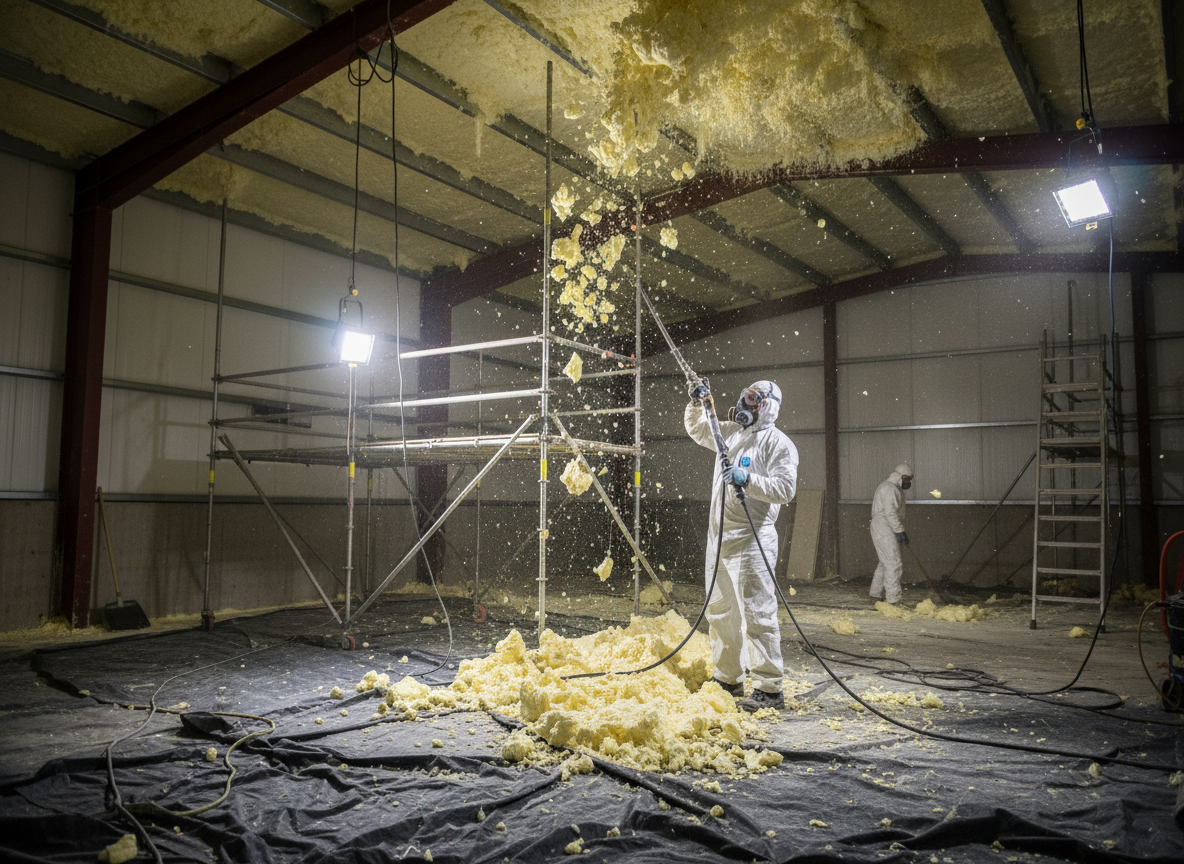
Telford's commercial building stock includes many 1970s industrial units around the Halesfield estate where spray foam was applied directly to metal decking and concrete roofs. Over time the foam absorbs moisture from the region's frequent rainfall and poor drainage on flat roofs, leading to widespread delamination and hidden corrosion. Removal crews must first establish negative pressure containment because disturbing aged foam releases fine particles that can migrate through shared ventilation systems in adjacent units.
Edge cases common in the Telford area involve foam installed over original asbestos-containing roof coatings. Any commercial job begins with a visual and tactile inspection of the substrate; if suspect materials appear, work stops until testing confirms safe removal methods. Thick layers applied in multiple passes also trap moisture pockets that can flash to steam when power tools are used, so operators work in controlled passes with constant moisture monitoring.
Local terrain plays a role too. Units on the slight slopes around Halesfield often have roof falls that direct water toward perimeter walls, so removal plans include temporary drainage protection to prevent runoff into neighbouring premises during the job. Post-removal, the exposed deck must be cleaned to a standard that accepts new insulation without adhesion failure, which requires specific surface preparation techniques suited to the original construction methods still found throughout the Telford new-town industrial zones.
Technician insight
In Telford, the thing that catches most people out with Commercial Spray Foam Removal is how uneven settlement in 1970s Halesfield concrete decks leaves the foam bonded in patches, so you end up chasing material into every low spot instead of lifting clean sheets.
Halesfield Warehouse Roof
A distribution unit near Halesfield 10 reported recurring leaks through the roof. Inspection showed spray foam delaminating over corroded metal decking. We installed full containment, removed the foam in sections while protecting the original deck, then prepared the surface for new insulation. The client reopened the space within the agreed schedule with no disruption to neighbouring units.
How it works
- 1
Initial Site Survey
Measure foam depth, assess substrate condition and identify any mixed materials in the Telford commercial unit.
- 2
Containment Setup
Install negative pressure zones and dust barriers to protect adjacent warehouse spaces and shared services.
- 3
Foam Extraction
Remove foam in controlled layers using appropriate tooling while monitoring for hidden moisture or contaminants.
- 4
Substrate Preparation
Clean and inspect the exposed deck, addressing corrosion or residue before handover for new insulation.
- 5
Final Clearance
Remove all waste, verify air quality and provide documentation for the commercial property records.
Pricing
Upfront quotes provided after on-site inspection of foam depth, access and any mixed materials.